
Blog
For the past few years, the narrative surrounding artificial intelligence has been dominated by breakthroughs in software: generative models, natural language processing, and automated productivity tools. However, behind every sophisticated algorithm lies a far less virtual reality. As technology megacaps continue their massive capital expenditure (capex) spending sprees, the market impact of artificial intelligence has expanded far beyond chip designers and software platforms. We have entered the era of the physical AI infrastructure cycle. Building and training next-generation large language models requires an unprecedented amount of computational power. Datacenters are no longer merely warehouse spaces filled with server racks; they are hyper-dense, power-hungry industrial facilities. As a result, the primary bottlenecks for AI adoption are shifting from software engineering to physical supply chains, electrical grid capacity, and energy production.
This shift is quietly reshaping broad market equity performance. Technology giants are deploying tens of billions of dollars into real-world assets, driving structural demand across traditionally defensive sectors:
- Utilities and Power Generation: AI datacenters require massive, continuous baseload power. Electricity providers, nuclear plant operators, and renewable energy developers are seeing historic spikes in forward demand, turning utilities into high-growth opportunities.
- Industrial and Electrical Equipment: Upgrading national power grids to handle high-voltage datacenter inputs requires specialized transformers, switchgear, and cooling systems. Manufacturers of heavy electrical equipment are seeing record order backlogs.
- Commodities and Materials: Expanding grid connections and building computational facilities requires massive inputs of industrial metals—most notably copper and aluminum—further tightening physical supply chains globally.
Investors who previously viewed artificial intelligence as purely a tech-sector play are recalibrating their portfolios. High valuations in semiconductor and software stocks have led capital to rotate into the foundational industries required to power those chips. The primary takeaway for modern markets is clear: software may be driving the future of work, but physical infrastructure remains the gating factor. Until power grid capacity, hardware supply chains, and specialized industrial equipment catch up to demand, the most critical story in finance isn't just who builds the best model—it's who supplies the power to run it.
Prompt Development
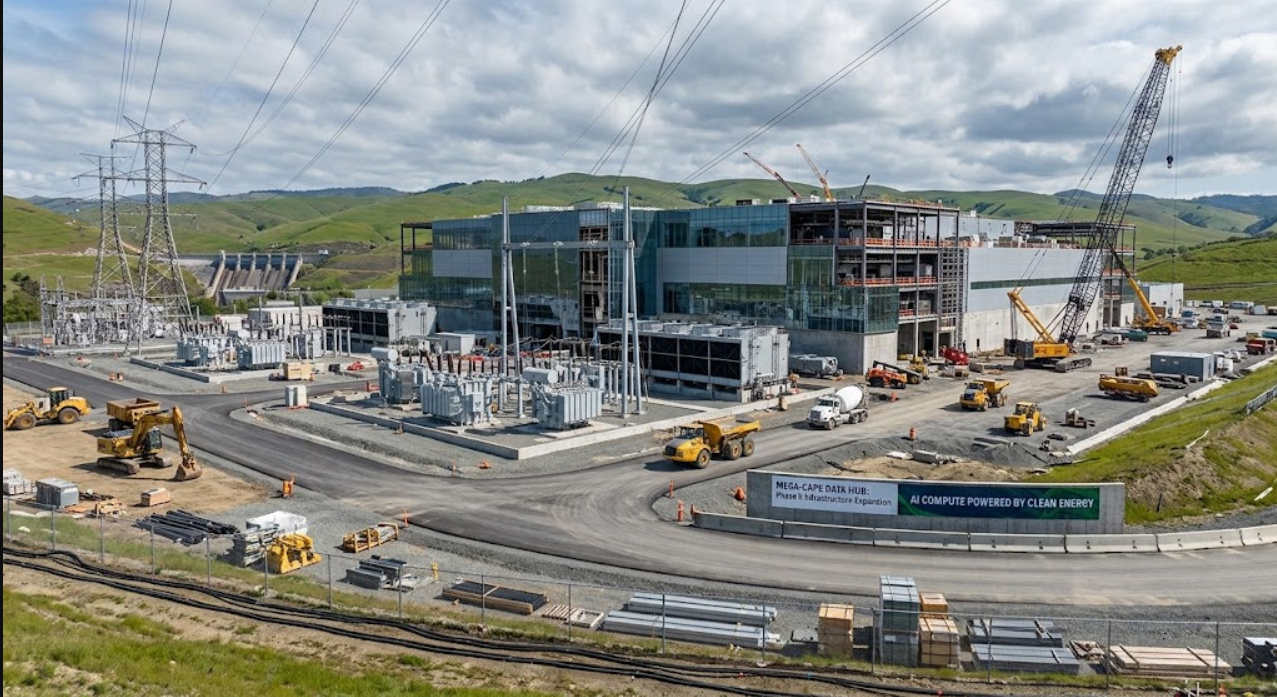
Original Prompt: "A realistic wide shot of a massive AI data center under construction next to an electrical substation and high-voltage power lines, with heavy machinery, concrete structures, and a banner that reads 'AI Compute Powered by Clean Energy'."
Final Prompt: "A raw, high-resolution editorial photograph of a massive AI data center facility under active construction, featuring realistic ambient lighting, highly detailed concrete textures, gritty construction dust, cranes, high-voltage electrical transformers, and power lines against rolling green hills on an overcast day."
Key Changes & Effect: Shifting the prompt focus from general descriptive labels to photographic terms ("editorial photograph," "ambient lighting," "detailed concrete textures") eliminated the overly clean, 3D-rendered look and brought natural depth, grain, and atmospheric realism to the final output.
Following Instructions
What it understood well: The generator accurately captured complex spatial layouts, including the integration of heavy construction equipment, structural steel frameworks, and high-voltage power lines.
What it struggled with: It struggled with rendering legible, typo-free text on background banners and occasionally produced subtle geometric inconsistencies in intricate structural details like lattice transmission towers and chain-link fencing.
Usefulness
AI-generated images allow organizations to rapidly prototype marketing concepts, create bespoke visual assets for internal slide decks or blog posts, and visualize prospective architecture or product designs long before physical assets exist—saving significant time and stock media costs.
Concerns and Disadvantages
Organizations must navigate copyright ambiguity surrounding AI output ownership, potential brand risk from hallucinated or inaccurate visual details, and ethical concerns regarding job displacement in creative fields. Furthermore, the immense computational power required to train and run image models consumes significant electricity and cooling water, adding environmental trade-offs to AI adoption.
Misinformation
Hyper-realistic AI images can be used to forge fake news events, fabricate corporate scandals, or spread political propaganda that deceives the public. To verify authenticity before sharing, users should reverse-image search the file, check for source metadata, inspect subtle visual anomalies (like unnatural hands, distorted backgrounds, or unreadable text), and cross-reference claims with trusted news outlets.
Your Evaluation
Yes, but with minor post-processing. The generated image effectively illustrates the high-capital, energy-intensive nature of AI expansion—a perfect match for the blog post's core message. However, before publishing, I would touch up the background signage to fix minor text artifacts and ensure full visual clarity.
AI Disclosure
The images were created using Google's Imagen model integrated within Gemini.