
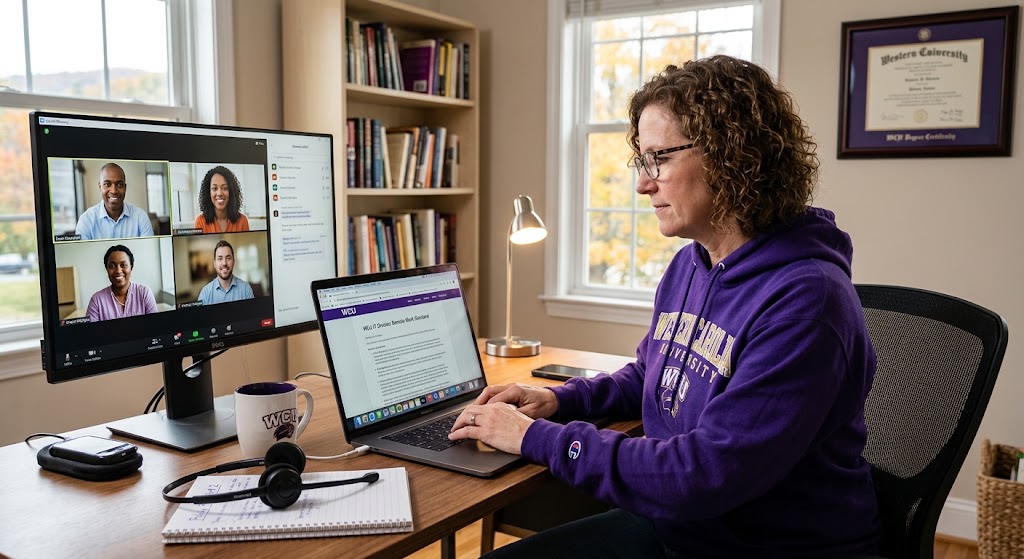
Artificial intelligence models are increasingly integrated into workplace environments to retrieve policies, summarize documentation, and streamline operations. However, a major challenge in deploying large language models (LLMs) is their tendency to generate plausible-sounding answers when given incomplete or no authoritative source material.
To evaluate how AI performance shifts when provided with authoritative context versus relying on internal training data, I conducted a two-part experiment using WCU Amplify. I asked five similar policy questions regarding Western Carolina University (WCU) and North Carolina State telework guidelines—first without providing source documents, and then with the authoritative WCU IT Division Remote Work Standard and NC Office of State Human Resources (OSHR) Teleworking Policy documents attached.
Amplify's Response Without Sources
Eligibility:
- Likely requires employees to have been in their position for a minimum period (e.g., 90 days to 6 months)
- Probably limited to roles deemed suitable for remote work (likely excluding facilities, IT on-site support, etc.)
- May require meeting performance standards
- Possibly excludes student workers or temporary employees
Approval Authority: - Supervisor/manager approval is almost certainly required first
- Department head or director likely must sign off
- IT Division leadership probably has final approval authority
- May require HR sign-off on security and compliance aspects
Remote Employee Responsibilities: - Likely includes maintaining cybersecurity measures (VPN use, password security)
- Probably requires secure data handling and no unsecured networks
- Likely includes availability during core business hours
- Probably requires maintaining professional communication standards
- May include compliance with data protection policies
Changes/Termination:
- Likely can be modified or ended by either employee or employer
- Probably requires notice period
- May be terminated for performance issues or policy violations
- Likely can be changed due to operational needs
Comparison to NC State Telework Policy: State policy likely focuses on classified state employees; WCU is a public university with potentially more flexibility
University may have more detailed tech security requirements
Amplify's Response With Sources
Eligibility for Remote Work
Based on the IT Remote Work Standard, eligible employees include:
Full-time and part-time (half-time or more) permanent, probationary, trainee, and time-limited employees
Not eligible: Temporary, intermittent, and part-time (less than half-time) employees
The policy emphasizes that remote work is not automatic or guaranteed—it's entirely at IT Division leadership's discretion. Positions must have job responsibilities suitable for remote work, and directors must demonstrate clear benefits to the department and university.
Approval Authority
Multi-level approval is required:
First level: Department director reviews and approves
Final authority: Chief Information Officer (CIO) must approve all agreements
The agreement is then submitted to Human Resources for monitoring and reporting
Employee Responsibilities While Remote Working
Employees must:
Maintain work hours: Same total hours and schedule as on-site work; no unapproved overtime
Be available: Accessible via phone, webcam, Zoom/MS Teams, and email during scheduled hours
Ensure adequate internet: Sufficient bandwidth for simultaneous Zoom meetings, email, Teams, and system access
Create professional workspace: Quiet, organized, well-lit environment recognizable as a place of business
Maintain safety: Complete home office assessment checklist; maintain hazard-free workspace
Protect data: Follow security and data handling procedures; safeguard confidential information
Return to duty station: Report on-site as needed for meetings, training, or work support
Return all property: Ensure return of university equipment upon termination of arrangement
Modification and Termination
Yes, arrangements can be changed or ended at any time, specifically:
By management discretion: The university may terminate for any reason without grievance rights
Grounds for termination:
- Department/operational needs change
- Employee performance does not meet expectations
- Safety concerns
- Employee conduct issues
Notice required: Generally 10 business days notice, unless safety/conduct issues warrant shorter notice
Modifications: Require written approval by director and CIO approval
Employee initiated: Employee may request to return to central workplace; university should reasonably accommodate
Question
Question #1: Who is eligible for remote work?
Question #2: Who must approve a remote-work arrangement?
Question #3: What responsibilities does an employee have while working remotely?
Question#4: Can an arrangement be changed or ended? Under what circumstances?
Question #5: How does WCU’s policy compare with NC’s state telework policy?
Policy
WCU IT Remote Work Standard & NC OSHR Policy §2: Eligible positions include full-time/part-time permanent, probationary, trainee, and time-limited employees. Temporary, intermittent, and part-time (less than half-time) employees are explicitly ineligible. Remote work is not automatic and is at management discretion.
WCU IT Remote Work Standard & NC OSHR Policy §8: Multi-level approval is required: first by the Department Director, with final approval authority resting with the Chief Information Officer (CIO). The agreement is then submitted to HR for monitoring/reporting.
WCU IT Remote Work Standard & NC OSHR Policy §7: Employees must maintain identical work hours/schedules without unapproved overtime, maintain phone/Zoom/Teams availability, ensure adequate internet bandwidth, maintain a quiet/safe workspace (completing a safety assessment), protect confidential data, report on-site as needed, and return property upon termination.
WCU IT Remote Work Standard & NC OSHR Policy §9: Management may modify or terminate agreements at any time for operational changes, performance gaps, safety concerns, or conduct issues. Requires 10 business days notice unless safety/conduct warrants shorter notice. Termination by management is non-grievable.
NC OSHR Teleworking Program Policy: WCU’s IT Remote Work Standard derives authority from and aligns directly with the statewide NC OSHR Teleworking Program Policy. Both reinforce that telework is a discretionary management option rather than a universal employee right or benefit.
Evaluation
Partially Accurate
Partially Accurate
Accurate
Partially Accurate
Inaccurate
What Does this Mean for AI At Work?
Did the Source Material Make a Difference?
After completing the unassisted query, I opened a second, completely separate conversation in Amplify and uploaded the official WCU IT Remote Work Standard, WCU Flexible Work Guidelines, and NC OSHR Teleworking Program Policy documents before asking the five questions again.
Key Observations & Comparison
Precision in Specific Details & Nomenclature:
In Part 1, Amplify relied on broad, speculative language—such as guessing a generic "90-day to 6-month" tenure requirement or assuming standard HR sign-offs. In Part 2, when provided with the governing documents, Amplify correctly named the exact administrative tiers and approval authorities involved, specifically identifying the Department Director for initial review and the Chief Information Officer (CIO) as the final approval authority for IT remote work agreements.
Correction of Hallucinations and Bad Assumptions:
Amplify previously assumed that state policy was broad while WCU acted with independent local flexibility. When fed the source material, it recognized that WCU's IT policy functions as a direct implementation of the overarching UNC System regulation 300.8.6 and the NC OSHR Teleworking Program Policy. It also retrieved exact procedural constraints, such as the standard 10 business days notice requirement for terminating a remote arrangement under normal operational shifts.
Inclusion of Actionable Policy Safeguards:
While both conversations correctly touched on core duties like maintaining work hours and data security, the second conversation incorporated specific compliance mechanisms found in the actual text, such as the mandatory Remote Work Home Office Assessment Checklist and the requirement for sufficient bandwidth to handle simultaneous Zoom and Teams video streams.
What Does This Mean for AI at Work?
1. Would You Trust the AI?
If I were a WCU employee attempting to clarify whether I could transition to a remote work arrangement, I would not rely solely on an unassisted AI response.
Although Amplify’s unassisted guesses sounded logical and professional, it fabricated key procedural requirements (such as tenure milestones and generic routing channels). Making career or compliance decisions based on unverified LLM output could lead to missed policy compliance or administrative errors. Even when the AI is supplied with authoritative source documents, its summaries should serve strictly as an initial navigational guide while the employee verifies the specific terms directly within official university portals or through human resources.
2. Information vs. Action
There is a critical boundary between giving an AI access to information and granting it the authority to take action:
Information Access: The AI acts as an informational assistant—reading, synthesizing, and explaining policy guidelines to human users.
Action Authorization: The AI acts as an autonomous agent—such as automatically approving, modifying, or denying a remote work application or contract change in an institutional database.
In a workplace, delegating action capabilities to an AI without human oversight introduces severe legal, financial, and ethical risks. If an AI misinterprets policy language and automatically denies a valid accommodation or revokes an employee's telework agreement, it creates immediate contractual and labor relations disputes.
Where Would You Draw the Line?
Supervised AI Task (Low Risk):
Task: Drafting routine internal communications, summarizing weekly team updates, or indexing reference documentation for internal search.
Reasoning: Minor errors in a meeting summary or internal index carry minimal risk and are easily caught and corrected during routine human review.
Human-Verified Task (High Risk):
Task: Approving employee telework agreements, processing formal HR accommodation requests, or initiating contractual changes.
Reasoning: These actions directly affect employment contracts, legal rights, and workplace equity. They require human judgment, empathy, and formal accountability.